Showing posts with label Empathy. Show all posts

Saturday, 10 August 2013

Contagious Yawning in Dogs and Humans: Are dogs more empathetic towards their owners?


(National Geographic, 8, August 2013) - Pets yawn more in response to owners' yawns than strangers', study says.


Dog owners who claim their pets know their feelings may be on to something: A new study shows that canines yawn more in response to their owners' yawns than they do to strangers' yawns.

That suggests dogs are "emotionally connected" to people, study leader Teresa Romero of the University of Tokyo said in a statement.

Scientists already knew that dogs sometimes yawn when they see people yawn, but it was unclear if that was considered a form of empathy or mild stress, as yawning can be caused by anxiety.

So Romero and her team set up an experiment in which 25 pet dogs watched both their owners and strangers yawn or pretend to yawn. (Read about why people yawn.)

The team ruled out stress when researchers saw no significant differences in the dogs' heartbeats during the experiments, according to the study, published August 7 in the journal PloS ONE.

Not only did the dogs in the study yawn more in response to their owners' yawns, they also yawned less when they saw fake yawns from their owners or from strangers, suggesting they were exhibiting true contagious yawning.

Contagious yawning occurs in humans, chimpanzees, baboons, and dogs.

In a similar study published last year, scientists found that people yawn more in response to the yawns of people they care about most.

In the case of people, scientists suspect that contagious yawning is a form of empathizing with people experiencing a feeling, which—in the case of yawning—usually means stress, anxiety, boredom, or fatigue.

Elisabetta Palagi, of the Institute of Cognitive Sciences and Technologies in Rome, noted that the study is the first time that scientists have shown contagious yawning occurring between different species.

"This could be the result of a long process of domestication," said Palagi, who wasn't involved in the study.  "Once more," she said, the study "demonstrates that dogs are capable of empathic abilities toward humans."

Monday, 18 February 2013

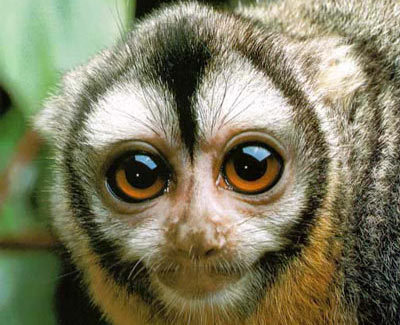
Chemistry of Love: Owl Monkeys Shed Light on Evolution of Love - [Article]


(National Geographic, 13, Feb 2013) - It may not seem like monkey business, but emotional bonds in animals such as primates may have evolved into love as we know it.


Take owl monkeys, tiny tropical tree-dwellers that treat every day like it's Valentine's Day. A male and a female stick together as long as possible, never cheat, and never "divorce" their mates—extremely unusual behavior, even among people. (Also see "Male Monkeys Wash With Urine to Attract Females?")

Sometimes, though, young adult owl monkeys that can't find mates—monkeys that scientists call floaters—pick vicious fights with established pairs, eventually kicking one of them out.

Now, new research shows that the monkeys forced to take on new partners have fewer babies than owl monkeys that haven't been broken up, said Eduardo Fernandez-Duque, a biological anthropologist at the University of Pennsylvania in Philadelphia who led a new study on owl monkey relationships.

The results show how monogamy helps owl monkeys—and may even shed light on how human relationships evolved, said Fernandez-Duque, who has received funding for his work from National Geographic's Committee for Research and Exploration. (National Geographic News is part of the National Geographic Society.)

"Call it love, call it friendship, call it marriage—there is something in our biology that leads to this enduring, emotional bond between two individuals that is widespread among human societies," Fernandez-Duque said in a statement.

Only about 5 percent of mammals are monogamous, and the phenomenon most often arises when both parents are needed to raise offspring, as in the case of people.

With owl monkeys, fathers take on most of the childcare after a baby is born, relying on the mother only for milk. (See video: "Owl Monkey Fathers Know Best?")

But floaters—which Fernandez-Duque and colleagues first noticed in 2003 in Argentina's Chaco region (map)—can spell trouble in paradise.

Drawing on nearly two decades of observations of 18 owl monkey groups, the team discovered that pairs that stay intact produce 25 percent more babies than monkeys in severed pairs.

The exiled animal from those broken relationships, meanwhile, is usually injured and often dies.

Since the team studied more than 150 animals, "I felt very confident that what he was telling us is a real phenomenon—it's not a flash in the pan," noted Patricia Wright, who was one of the first people to study owl monkeys in the 1980s.

"He had the goods on the animals. I was really excited about that," said Wright, an anthropologist at Stony Brook University in New York.

Wright said she was personally pleased that the study reinforced findings that owl monkeys stay true to one another unless forced to separate.

"I knew that these little monkeys didn't fool around," she said.

Why monkeys that are broken up have fewer babies is unknown, though Fernandez-Duque suspects there's an emotional component. (See more pictures of all-star animal dads.)

Just as a man and a woman need time to get to know each other and form a deep connection, so do owl monkeys. So when a marauding monkey enters into a new relationship, there's a delay in mating—usually about a year, Fernandez-Duque  said.

In fact, pair bonding in monogamous animals, such as owl monkeys, may be "sort of evolutionary antecedent to love in humans," said Larry Young, a behavioral neuroscientist at Emory University in Atlanta and author of the new book The Chemistry Between Us: Love, Sex, and the Science of Attraction.

Young, who studies the brain chemistry of love and emotion, does most of his research on monogamous prairie voles.

Though human love is a rich emotion reflective of our advanced brains, he said, "the foundation of that emotion is very similar to the neuromechanisms that are causing the bond between these two prairie voles."

For instance, experiments have shown that if a vole loses its partner, the "widowed" animal shows depressive symptoms—measured by a lack of willingness to escape a dangerous situation.

According to Young, our brains are in the love seat, so to speak: The organs "have evolved the mechanism to produce an emotional attachment," he said.

That attachment is spurred by oxytocin—produced during intimate contact in both people and animals—and dopamine, which is responsible for feelings of exhilaration and happiness.

So, many splendored as it is, love, he said, "is really the result of a cocktail of chemicals."

Tuesday, 15 January 2013

The Chimp Ultimatum: Study Reveals Origins of Human Fair Play - [Article]

The Ultimatum Game: When the first chimp takes a token and
 passes it to its partner, this represents an "offer"

(BBC Science, 15, Jan 2013) The human tendency to share may have more ancient evolutionary routes than previously thought.


This is according to a study of the performance of chimpanzees in a test called the "ultimatum game".

Traditionally, the game is employed as a test of economics; two people decide how to divide a sum of money.

This modified game, in which two chimps decided how to divide a portion of banana slices, seems to have revealed the primates' generous side.

The study, published in Proceedings of the National Academy of Sciences, was part of an effort to uncover the evolutionary routes of why we share, even when it does not make economic sense.

Scientists say this innate fairness is an important foundation of co-operative societies like ours.

Lead researcher Darby Proctor from the Yerkes National Primate Research Center at Emory University, US, explained why she and her colleagues chose to use the ultimatum game, which has been used in the past to illustrate the human tendency to share.

During the game, one participant is given an amount of money and asked to "make an offer" to the second player. If that second player accepts the offer, the money is divided accordingly.

But, if the second player refuses that offer, both players receive nothing. This is the basis of the fairness versus economics quandary; if the first player proposes a selfish, unequal offer, the affronted recipient might refuse.

And this is exactly what happens in humans. Although it makes economic sense to give away as little as possible and accept any offer that's proposed, people usually make roughly equal, or "fair" offers, and tend to refuse unequal or "unfair" offers.

Dr Proctor and her colleagues trained their chimp participants to play a similar game, using coloured tokens to represent a reward.

"We tried to abstract it a little - to make it a bit like money," Dr Proctor explained.

A previous attempt to test merit-based sharing among our closest living relatives, the chimpanzees, was published in a 2007 study published in the journal Science. Researchers using the ultimatum game found that chimps would take any reward - no matter what share they were offered. But the authors of this study say this may have been because the chimps were directly offered food which they found "difficult to resist".

While children appear to be prepared to share with a new playmate, non-human primates seem to limit their altruism to close kin and mates. But it is not simply the case that the more intelligent the species the more altruistic they are. Recent research on sharing published in PNAS in social primates revealed that capuchins and marmosets were some of the most "giving" primates - commonly offering food rewards to other group members

Before we feel too superior to our primate cousins, our capacity to be spiteful appears to be ours alone. A 2007 published in PNAS study found chimpanzees, unlike humans, do not retaliate against personally harmful actions. Being spiteful is a human trait

"We trained them with two different tokens.

"If they took [a white token], they would be able to split the food equally, and taking the other [blue] token meant that the first chimp would get more food than the partner."

The researchers presented both tokens to the first chimp, which would then choose one and offer it to its partner.

As with the human version of the game, if the partner accepted the token, both animals received their reward.

Three pairs of chimps played this game, and the results revealed that the animals had a tendency to offer a fair and equal share of the food reward.

In another experiment, the team repeated the test with 20 children between the ages of two and seven. They discovered that both young children and chimps "responded like humans typically do" - tending to opt for an equal division of the prize.

"What we're trying to get at is the evolutionary route of why humans share," explained Dr Proctor.

"Both chimps and people are hugely cooperative; they engage in cooperative hunting, they share food, they care for each other's offspring.

"So it's likely that this [fairness] was needed in the evolution of cooperation.

"It seems to me that the human sense of fairness has been around in primates for at least as long as humans and chimps have been separated."

Dr Susanne Schultz from the University of Manchester said the study was very interesting and showed "the potential for chimps to be aware of fair offers".

"It is interesting that changing the study design - primarily by not using food rewards it seems - one can elicit fairness behaviour in chimps," she told the BBC.

She added though that is was not clear that the chimps completely understood the design of the game and that, with just six chimps involved in the study, further evidence would be needed to show clearly that chimps had a natural tendency towards fairness.

Monday, 14 January 2013

Animals and Their People - [Photography]

A ranger inspects a 10-day-old baby elephant at
Sarah Deu conservation response unit in Sampoiniet, Aceh Jaya, Indonesia

(The Big Picture, 29, Oct 2012) - We keep them as pets, although which species maintains the upper paw in that relationship is sometimes in doubt. We drive them to the brink of extinction, and then make desperate attempts to bring them back. We tend them as livestock, display them in zoos, and research them in labs and in the wild. Our lives are intertwined with those of animals, and better for it. Gathered here are images of that furry interface. 

36 photos in collection

Tuesday, 8 January 2013

Human Kindness Also Found in Bonobos - [Article]

"I love you generic orange fruit stuff, never leave me"


(NYTimes.com, 7, Jan 2013) - Bonobos will happily share their food with a stranger, and even give up their own meal — but only if the stranger offers them social interaction, evolutionary anthropologists at Duke University report in the journal PLoS One. The researchers, Jingzhi Tan and Brian Hare, say their findings may shed light on the origins of altruism in humans.


Along with chimpanzees, bonobos are among the closest primates to humans. Chimpanzees, however, do not display similar behaviour toward strangers.

“If you only studied chimps you would think that humans evolved this trait of sharing with strangers later,” Mr. Tan said. “But now, given that bonobos do this, one scenario is that the common ancestor of chimps, humans and bonobos had this trait.”

The subjects were all orphaned bonobos at the Lola ya Bonobo sanctuary in the Democratic Republic of Congo. In one phase of the study, bonobos were given a pile of food, then given the opportunity to release a stranger or a group mate (or both) from other rooms.

The bonobos chose to release strangers and share their food. Not only that, but the just-released bonobo would then release the third.

“This was shocking to us because chimpanzees are so xenophobic,” Mr. Tan said. “They won’t approach a stranger unless they outnumber them.”

The apes did have a limit — they would not share their own food when no social interaction was involved.
They were, however, willing to help a stranger get food even without social interaction. Mr. Tan compared this to certain human acts of kindness.

“It’s like when you donate money and you don’t tell people,” he said, “so there’s no way for you to get any benefit.”

ShareThis