|
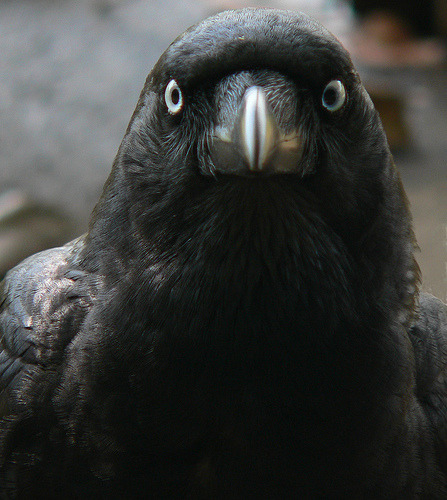
| Curious crow is curious |
(BBC Nature, 18, Sept, 2012) - Tool-making crows have the ability to "reason",
say scientists.
In an experiment, researchers found that crows were more
likely to forage when they could attribute changes in their environment to a
human presence.
This behaviour may suggest "complex cognition",
according to a study published in the Proceedings of the National Academy of
Sciences. Until now the ability to make inferences based on causes has
been attributed to humans but not animals.
The study was a collaboration between researchers from the
University of Auckland, New Zealand, the University of Cambridge, UK and the
University of Vienna, Austria.
In their experiment eight wild crows used tools to remove
food from a box. Inside the enclosure there was a stick and the crows were
tested in two separate series of events that both involved the stick moving.
In one instance a human entered the hide and the stick
moved. In the other, the stick still moved but no human entered. On the occasions when no human was observed entering the
hide, the crows abandoned their efforts to probe for food using a tool more
frequently than they did when a human had been observed.
According to the scientists, the study proved that crows
attributed the stick's movement to human presence.
The results indicated that neither age nor sex was a
predictor of the behaviour with juveniles, males and females displaying the
same behaviour. Scientists said that the kind of "reasoned
inference" shown by the New Caledonian crows under these controlled
conditions could also be utilised in the wild to anticipate danger or food.
The study is the first to suggest that animals have the
ability to make reasoned inferences, although scientists added that the phenomenon
could be more common among animals than previously thought.