|
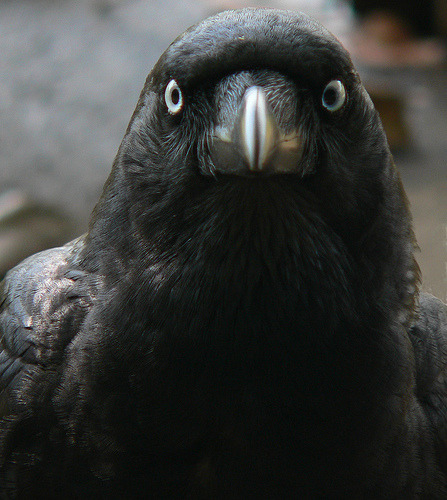
| "Soon... my Lego castle will be complete! Your people intelligence is no match for my bird intelligence" |
(ScienceNOW, 10, Jan 2013) - Are crows mind readers? Recent studies have suggested that
the birds hide food because they think others will steal it — a complex
intuition that has been seen in only a select few creatures. Some critics have
suggested that the birds might simply be stressed out, but new research reveals
that crows may be gifted after all.
Journal article: Corvid Re-Caching without ‘Theory of Mind’:A Model
Cracks first began forming in the crow mind-reading
hypothesis last year. One member of a research team from the University of
Groningen in the Netherlands spent 7 months in bird cognition expert Nicola
Clayton’s University of Cambridge lab in the United Kingdom studying Western
scrub jays, a member of the crow family that is often used for these studies.
The Groningen team then developed a computer model in which “virtual jays”
cached food under various conditions.
In PLOS ONE, they argued that the model showed the jays’
might be moving their food—or recaching it—not because they were reading the
minds of their competitors, but simply because of the stress of having another
bird present (especially a more dominant one) and of losing food to thieves.
The result contradicted previous work by Clayton’s group suggesting that crows
might have a humanlike awareness of other creatures’ mental states—a cognitive
ability known as theory of mind that has been claimed in dogs, chimps, and even
rats.
In the new study, Clayton and her Cambridge graduate student
James Thom decided to test the stress hypothesis. First, they replicated
earlier work on scrub jays by letting the birds hide peanuts in trays of ground
corn cobs—either unobserved or with another bird watching—and later giving them
a chance to rebury them. As in previous studies, the jays recached a much
higher proportion of the peanuts if another bird could see them: nearly twice
as much as in private, the team reports online today in PLOS ONE.
Then came the stress test. First, Thom and Clayton gave the
jays trays with the ground cobs but no food to hide in them—a so-called “sham”
session. Then, in a second session, they gave the birds new hiding trays and
bowls of peanuts to hide. When the jays were done, the experimenters removed
the trays and stole all of the peanuts. Finally, after a short break, the
researchers gave each bird yet another round of food, a new tray to hide it in,
and one of the trays it had seen earlier: either the sham tray or the ransacked
“pilfer” tray. The jays had 10 minutes for recaching.
If the Groningen model was correct, Thom and Clayton argue,
the stress of discovering that food was missing from the pilfer tray ought to
drive jays to cache more peanuts than those presented with the sham tray. In
fact, there was no difference, even though corvids have excellent memories for
hidden food and remarkable abilities to find it again. The hypothesis that jays
have theory of mind remains on the table, Thom says.
Thom and Clayton have “definitely shown that scrub recaching
is not as simple as the [Groningen] model presents it,” says Elske van der
Vaart, lead author of the Groningen team’s earlier report, who is now at the
University of Amsterdam. But she argues that there is still room for doubt
about what the results mean. For example, the sham condition—in which the jays
had no food to cache—could have stressed the birds as much as the stolen peanuts
in the pilfer condition did.
Amanda Seed, an animal cognition researcher at the
University of St. Andrews in the United Kingdom, says the Groningen model’s
failure to predict the birds’ caching behavior in the new experiments could
“bring the model down like a pack of cards.” But researchers still have to rule
out other possible explanations, she says. For example, the birds given
pilfered tray may have noticed the missing peanuts too late to affect their
overall caching rate, or they may have spent much of their time looking for the
missing nuts instead of hiding the new ones. The Cambridge and Groningen groups
are planning more work with both real and “virtual” birds to see what is really
going on. “I applaud them for rising to the challenge,” Seed says.