"Oh such juicy brains there are here at TED....mmmm"
Tuesday, 18 September 2012
The mysterious, "You don't understand me!", workings of the adolescent brain

Crows can 'reason' about causes, a recent study finds
 |
| Curious crow is curious |
(BBC Nature, 18, Sept, 2012) - Tool-making crows have the ability to "reason", say scientists.
In an experiment, researchers found that crows were more
likely to forage when they could attribute changes in their environment to a
human presence.
This behaviour may suggest "complex cognition",
according to a study published in the Proceedings of the National Academy of
Sciences. Until now the ability to make inferences based on causes has
been attributed to humans but not animals.
The study was a collaboration between researchers from the
University of Auckland, New Zealand, the University of Cambridge, UK and the
University of Vienna, Austria.
In their experiment eight wild crows used tools to remove food from a box. Inside the enclosure there was a stick and the crows were tested in two separate series of events that both involved the stick moving.
In one instance a human entered the hide and the stick
moved. In the other, the stick still moved but no human entered. On the occasions when no human was observed entering the
hide, the crows abandoned their efforts to probe for food using a tool more
frequently than they did when a human had been observed.
According to the scientists, the study proved that crows
attributed the stick's movement to human presence.
The results indicated that neither age nor sex was a
predictor of the behaviour with juveniles, males and females displaying the
same behaviour. Scientists said that the kind of "reasoned
inference" shown by the New Caledonian crows under these controlled
conditions could also be utilised in the wild to anticipate danger or food.
The study is the first to suggest that animals have the
ability to make reasoned inferences, although scientists added that the phenomenon
could be more common among animals than previously thought.
Journal reference: New Caledonian crows reason about hidden causal agents - http://www.pnas.org/content/early/2012/09/10/1208724109
Monday, 17 September 2012
Crows can remember and differentiate human faces
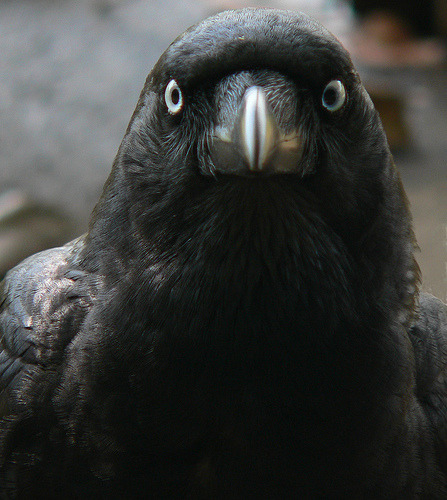 |
| "I know I know you" - The Crow (1994) |
(New Scientist, Sept, 10, 2012) - You can
run from a crow that you've wronged, but you can't hide. Wild crows remember
human faces in the same way that mammals do.
Crows
can distinguish human faces and remember how different people treated them,
says John Marzluff of the University of Washington in Seattle.
To work out how the crows process this information, Marzluff had members of his team wear a latex mask as they captured 12 wild American crows (Corvus brachyrhynchos). The crows learned to associate the captor's mask with this traumatic experience. While in captivity, the crows were fed and looked after by people wearing a different mask.After four weeks, the researchers imaged the birds' brains while they were looking at either the captor or feeder mask. The brain patterns looked similar to those seen in mammals: the feeder sparked activity in areas involved in motivation and reward, whereas the captor stimulated regions associated with fear.
The result makes sense, says Kevin McGowan of Cornell Lab of Ornithology in Ithaca, New York. Crows don't mind if humans are in their habitat – but they need to keep a close eye on what we do.
Journal reference: Proceedings of the National Academy of Sciences, DOI: 10.1073/pnas.1206109109
Size Does Matter. Brain Size!
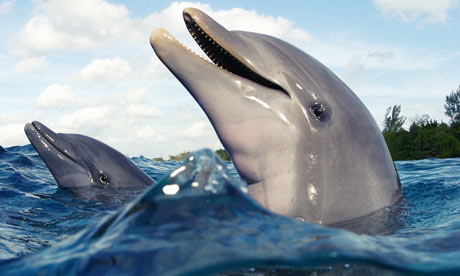 |
| Big brains, but all they want to talk about is mackerel. |
(Discover Magazine, Sept, 11, 2012) - Every whale and dolphin evolved from a deer-like animal with slender, hoofed legs, which lived between 53 and 56 million years ago.
Over time, these ancestral creatures became more streamlined, and their tails widened into flukes. They lost their hind limbs, and their front ones became paddles. And they became smarter. Today, whales and dolphins – collectively known as cetaceans – are among the most intelligent of mammals, with smarts that rival our own primate relatives.
Now, Shixia Xu from Nanjing Normal University has found that
a gene called ASPM seems to have played an important role in the evolution of
cetacean brains. The gene shows clear signatures of adaptive change at two
points in history, when the brains of some cetaceans ballooned in size. But
ASPM has also been linked to the evolution of bigger brains in another branch
of the mammal family tree – ours. It went through similar bursts of accelerated
evolution in the great apes, and especially in our own ancestors after they
split away from chimpanzees.
It seems that both primates and cetaceans—the intellectual
heavyweights of the animal world—could owe our bulging brains to changes in the
same gene. “It’s a significant result,” says Michael McGowen, who studies the
genetic evolution of whales at Wayne State University. “The work on ASPM shows
clear evidence of adaptive evolution, and adds to the growing evidence of
convergence between primates and cetaceans from a molecular perspective.”
For decades, we’ve known that similarities between primate
and cetacean intelligence run deep. For a start, both groups have members with
unusually big brains. We humans have brains that are 7 times bigger than you’d
expect for an animal of their size. The equivalent number is 2-3 for chimps and
some monkeys, and 4-5 for some dolphins.
Over the last decade, scientists have identified seven genes
that are linked to primate brain size. They’re called MCPH1 to MCPH7 (ASPM is
the fifth in the line). Faults in these genes can lead to microcephaly – a
developmental disorder characterised by a debilitatingly small brain.
McGowen had already shown that, unlike in humans, MCPH1
doesn’t neatly correlate with brain size in cetaceans. Xu wanted to see if ASPM
would be more interesting. He sequenced the gene in fourteen species of
cetaceans, from the bottlenose dolphin to the minke whale. He then compared
these to known sequences from 18 other mammals, including several primates and
the hippopotamus (the closest living relative to cetaceans).
Xu found that ASPM went through two periods of strong
positive selection – where beneficial new versions of the gene spread through a
population. The first coincides with the point when toothed whales (like sperm
whale and dolphins) split away from the baleen whales (like blue, fin and
humpback whales). Their brains got bigger. The second period marks the split of
the toothed whales into the delphinoids (including all oceanic dolphins and
porpoises) and all the others. The delphinoids’ already big brains got bigger
still.
Xu also found signatures of positive selection within the
ASPM genes of primates, but not in any other mammal groups. During their
history, both groups must have experienced some evolutionary pressures that
meant bigger brains suddenly became advantageous. We can only speculate what
these might have been. For cetaceans, the toothed whales evolved to navigate
with echolocation, and may have needed a larger brain to process the
information from all the returning echoes. The delphinoids may owe their larger
brains to the mental demands of living in large, complex social groups. (Both
hypotheses have been on the cards for some time, and Xu’s ASPM discovery
doesn’t provide a smoking gun for either.)
What does ASPM actually do? The gene is activated in neuroblasts,
the embryonic cells that eventually divide into neurons. It helps to create
structures in dividing cells that send a full complement of DNA into each
daughter. If ASPM isn’t working properly, the neuroblasts cannot divide evenly,
and brains get smaller. It’s not clear how the reverse happens – how changes in
ASPM lead to bigger brains, but it’s now clear that this has happened in at
least two mammal groups.
Xu found certain mutations that were associated with the
bigger brains of toothed whales, and others that are associated with the even
bigger brains of delphinoids. What these mutations did is anyone’s guess, and
something that will take a lot of experimental work to uncover.
Here’s one critical nugget, though: they’re different to the
changes you see in primates. The same gene may have enlarged the brains of both
groups, but it did so in different ways. And undoubtedly, other genes were also
involved.
(To close, here’s possibly my favourite ever example of
convergent evolution, which also involves cetaceans. Toothed whales and some
bats both use echolocation, and their abilities depend on the same changes to
the same gene – Prestin. This was discovered at the same time by two
independent groups of researchers, one led by Yang Liu and the other by Ying
Li!)
Reference: Xu, Chen, Cheng, Yang, Zhou, Xu, Zhou & Yang.
2012. Positive selection at ASPM gene coincides with brain size enlargements in
cetaceans. Proc Roy Soc B.
Monday, 17 October 2011
Evolutionary Comparison Finds Shocking History for Vertebrates
 |
| !!0_0!! |
About 500 million years ago there was probably a predatory marine fish with good eyesight, powerful jaws and sharp teeth roaming the oceans, sporting a lateral line system for detecting water movements and a well-developed electroreceptive system to sense predators and prey around it. The vast majority of the 65,000 or so living vertebrate species are its descendants.
A few hundred million years ago, there was a major fork in the evolutionary tree. One lineage led to the ray-finned fishes, or actinopterygians, and they’ve kept a weak electroreceptive system to this day. Sturgeon have receptors in the skin of their heads, for example, and the North American paddlefish has 70,000 receptors in its snout and head.
The other lineage led to lobe-finned fishes, or sarcopterygians, which in turn gave rise to land vertebrates. Some land vertebrates, including salamanders like the Mexican axolotl, still have electroreception. But in the change to terrestrial life, the lineage leading to reptiles, birds and mammals lost that electrosense and the lateral line.
The researchers took the axolotl (to represent the evolutionary lineage leading to land animals) and the paddlefish (as a model for the branch leading to ray-finned fishes) to find out the history of this sense. They found that electrosensors develop in precisely the same pattern from the same embryonic tissue in the developing skin, confirming that this is an ancient sensory system.
Also, the electrosensory organs develop immediately adjacent to the lateral line, providing compelling evidence “that these two sensory systems share a common evolutionary heritage,” said Willy Bemis, Cornell professor of ecology and evolutionary biology and a senior author of the paper.
Bemis and his colleagues will now be able to build a better picture of what the common ancestor of these two lineages looked like.
Clever Test Shows Meerkat Voices Are Personal
 |
| "Alan! Alan! Alan! ...oh it's not Alan. Jeff!!" |
The findings are based on tests in which calls from the same individual were played near-simultaneously in two different locations. The implications go beyond meerkats.
Humans and many primates clearly recognize individual voices, a capacity considered fundamental for rich social lives. Some mammals, such as dolphins, have demonstrated the ability in captive settings. But while recognizing voices seems obvious — how else could Meerkat Manor make sense? — it’s been surprisingly difficult to design quantitative studies for truly wild animals other than primates, leaving an important aspect of animal social life in empirical shadow.
“Understanding how animals experience the individuals within their social worlds is key to deciphering the evolution of social and communicative capacities,” write researchers led by University of Zurich ethologist Simon Townsend in their new meerkat study, published Oct. 11 in Biology Letters.
Of course, many animals clearly recognize individuals by scent and sight. But those abilities are considered less cognitively-demanding than vocalizations, which can be highly complex and imply mental representations of other individuals. The late, great ethologist Donald Griffin called vocalizations a window into animal minds.
For primates, the best-studied vocalizers, social relationships are often so complex and self-evident that it’s possible to play recordings of individual voices, then see how animals respond. A chimp will, for example, react differently to the voice of each different member of his group.
As for other mammals, experiments in natural settings have tended to involve tests of whether individuals respond to their kin, as with leopard seals recognizing their pups’ cries, or to general social categories.
In one unpublished study, meerkats responded differently to the voices of a group’s dominant female, but it wasn’t clear whether they recognized the individual or simply some categorical sign of dominance.
But Townsend’s team came up with a deceptively simple test that posed a physically impossible scenario to any meerkat capable of recognizing individual voices.
Using hidden speakers, they played recorded calls from one individual on one side of a target meerkat, and then from the other. The situation was similar to hearing a friend shout from the kitchen, then from the second-floor bathroom just a second later.
The meerkats reacted with a prolonged vigilance, paying much closer attention than they did to other recorded calls. The situation didn’t compute.
According to Townsend, the methodology could be applied to other animals that haven’t yet been studied, producing an animal kingdom-wide picture of individual voice recognition. That picture could help show what makes humans special — or, conversely, what seemingly special abilities are actually widespread.
“You see this ability in primates, which you’d expect,” said Townsend. “But the fact that we can show this in non-primate social mammals suggests the skill is omnipresent. It suggests that humans aren’t so unique.”
Children Like Teamwork More Than Chimps Do

When all other things are equal, 3-year-old children prefer to do a task collaboratively rather than alone, while chimpanzees show no such preference, said study researcher Yvonne Rekers, a cognitive scientist at the Max Planck Institute for Evolutionary Anthropology in Germany.
"We expected that difference between human and chimpanzee cooperation, because we can see it nowadays," Rekers told LiveScience. "Humans collaborate in a larger variety of contexts and in more complex forms."
However, that leaves the question: Why these differences in cooperation? Cognitive abilities may be at the root of some of them, Rekers said, but motivation could matter as well.
Working together
To investigate the motivations of both species, the researchers chose a task that both groups would willingly undertake: pulling a rope to get a food reward. The children in the study got gummy frogs as their treat, while the chimpanzees got bananas.
Fifteen chimps and 24 children were introduced to the same experimental set-up: a room containing both a single end of rope and a doubled-over rope with two available ends. The 3-year-olds and the chimps were all taught that by pulling both ends of the doubled-over rope at the same time, they could draw a food-laden board toward them, delivering a batch of gummy frogs or bananas.
Pulling the single rope would produce the identical food reward, but only with the help of another child or chimp in the room next door, who had to pull the opposite end of the rope at the same time. (The child or chimp acting as the potential partner in the experiment wasn't being tested; he or she had only the single end to pull. The potential partners were, however, highly motivated to pull that rope, because they too knew that a food reward would be coming their way.)
Cooperating kids
Despite the fact that the chimps got their food four to five seconds faster when they pulled the single end and worked with a partner than when they pulled both ends of the doubled rope by themselves, they were just as likely to choose the doubled rope, the researchers said. The chimps chose the single-ended rope 58 percent of the time, a number not significantly different than chance.
The 3-year-old children, by contrast, chose to pull the collaborative single rope in 78 percent of trials, even though it did not produce snacks any faster.
The children had all practiced the game beforehand and so knew how it worked. They, like the chimps, could see their potential partner through a opening between the two rooms. But to make their experience more like that of the chimps, the kids were encouraged not to speak during the experiment.
In order to keep all factors constant, a snack went to the cooperating child (the one not being tested) regardless of whether he or she was called upon to pull. That set-up, however, led Rekers and her colleagues to worry that perhaps the tested children were picking the collaborative work to prevent their partners from getting gummy frogs for doing nothing.
The researchers set up a second experiment with 12 new children in which the potential partner never received a reward — at least not within the sight of the tested child. The results were essentially unchanged, with 81 percent of kids choosing to work together. That finding suggested that the original result was not influenced by any desire to prevent freeloaders.
Rekers and her colleagues aren't sure whether this preference for cooperation is innate in humans or not, but one theory is that evolutionary pressures at some point nudged humans, but not chimps, into becoming cooperative foragers. The next step, Rekers said, is to study other primate species, such as bonobos.
She said she also plans to look into what children get out of working together.
"Is it just that they enjoy doing stuff together?" she said. "Or are they following other strategies or goals?"
Subscribe to:
Posts (Atom)