Showing posts with label Complex Social Groups. Show all posts

Tuesday, 6 August 2013

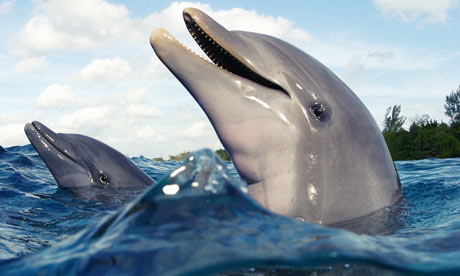
Dolphins recognise their old friends even after 20 years of being apart


(The Independent – 7, August 2013) - New study shows that the mammals have the longest social memory of any non-human species

Dolphins are able to remember one another's signature calls for at least 20 years making it the longest memory for "faces" among animals - perhaps even surpassing the ability of people to remember one another from their appearances alone.

Every dolphin has a unique whistle which is used as a signature call and stays with them unchanged throughout life. These identifying noises are even more reliable than the facial features used by people to recognise each other, which notoriously change over time.

Now a study has shown that when dolphins have been separated for 20 years or more they are still able to distinguish the whistle call of a former close companion from a host of other calls emitted by complete strangers, scientists said.

This kind of "social memory" surpasses the recognition abilities of elephants, primates and all other intelligent animals that have been studied in this way, said Jason Bruck, who carried out the work whilst studying for is PhD at the University of Chicago.

"This research shows that dolphins have the potential for lifelong memory for each other regardless of relatedness, sex or duration of association. This is the first study to show that social recognition can last for at least 20 years in a nonhuman species," Dr Bruck said.

"This shows us an animal operating cognitively at a level that's very consistent with human social memory. This is the kind of study you can only do with captive groups where you know how long the animals have been apart. To do a similar study in the wild could be almost impossible," he said.

The study, published in the journal Proceedings of the Royal Society of London B, involved collecting the recorded signature whistles of 53 different bottlenose dolphins living at six different facilities, from the Brookfield Zoo near Chicago to Dolphin Quest in Bermuda.

The dolphins at these sites are part of a captive-breeding programme and they have periodically spent time together going back many years, complete with fully-verified records.

During the study, Dr Bruck would play a recording of signature whistles of a stranger that a dolphin had never heard before. After repeating the call many times, the dolphin would quickly show signs that it is bored with the sound of another dolphin it had never met, he said.

Dr Bruck then introduced the call of a dolphin they had once known, and measured its response and behaviour. "When they hear a dolphin they know, they often quickly approach the speaker playing the recording. At times they will hover around, whistle at it, try to get it to whistle back," Dr Bruck said.

In one notable example, for instance, a female named Allie living at Brookfield Zoo recognised and responded to a recorded call of female called Bailey, now living in Bermuda, which had shared a pool with Allie 20 years and six months previously when they both lived at Dolphin Connection in Florida Keys, he said.

Dolphins are thought to live for about 20 years on average in the wild, although they are known to live as long as 45 years in captivity. It is possible that they social memory for signature whistles could last their lifetime, Dr Bruck said.

This is the longest, scientifically-tested social memory in animals, matched only by the anecdotal reports of elephants being able to recognise their mothers after 20 years of separation.

A study published earlier this year by researchers at the University of St Andrews found that dolphins not only recognised each other by their whistles but often mimic a close companion's unique whistle in an attempt to get them to respond.

"We know they use these signatures like names, but we don't know if the name stands for something in their minds the way a person's name does for us. We don't know yet if the name makes a dolphin picture another dolphin in its head," Dr Bruck said.


Tuesday, 16 October 2012

Are Humans Monogamous or Polygamous?

Photo by Georges Gobet/AFP/Getty Images.
"My eyes are up here pal" 

(Slate.com, 9, Oct 2012) - Archaeologists, anthropologists, and biologists agree: It’s complicated.

What makes us different from all the other animals? Is it our swollen brains, our idle hands, or perhaps our limber thumbs? In 2011, a research team reviewed the quirks of human DNA and came across another oddly shaped appendage that makes us who we are: I mean, of course, man's smooth and spineless member. The penises of lots of mammals are endowed with "horny papillae," hardened bumps or spikes that sometimes look like rows of studs on a fancy condom. These papillae enhance sensation, or so it has been claimed, and shorten a mating male's delay to climax. Since humans lost their phallic bumps several million years ago, it could be that we evolved to take it slow. And it could also be the case that longer-lasting sex produced more intimate relationships.

So (one might argue that) the shedding of our penis spines gave rise to love and marriage, and (one could also say that) our tendency to mate in pairs pushed aside the need for macho competition, which in turn gave us the chance to live together in large and peaceful groups. Life in groups has surely had its perks, not least of which is that it led to bigger brains and a faculty for language, and perhaps a bunch of traits that served to civilize and tame us. And so we've gone from horny papillae to faithful partners—from polygamy to monogamous humanity.

I like this story well enough, but it may or may not be true. In fact, not all penis spines in nature serve to quicken sex—orangutans have fancy ones but waste a quarter of an hour in the act—so we don't know what to make of our papillae or the lack thereof. That won't stop anyone from wondering.
Since we like to think that how we mate defines us, the sex lives of ancient hominids have for many years been examined in computer simulations, by measuring the circumferences of ancient bones, and by applying the rules of evolution and economics. But to understand the contentious field of paleo-sexology, one must first address the question of how we mate today, and how we’ve mated in the recent past.

According to anthropologists, only 1 in 6 societies enforces monogamy as a rule. There's evidence of one-man-one-woman institutions as far back as Hammurabi's Code; it seems the practice was further codified in ancient Greece and Rome. But even then, the human commitment to fidelity had its limits: Formal concubines were frowned upon, but slaves of either sex were fair game for extramarital affairs. The historian Walter Scheidel describes this Greco-Roman practice as polygynous monogamy—a kind of halfsy moral stance on promiscuity. Today's Judeo-Christian culture has not shed this propensity to cheat. (If there weren't any hanky-panky, we wouldn't need the seventh commandment.)

In The Myth of Monogamy, evolutionary psychologists David P. Barash and Judith Eve Lipton say we're not the only pair-bonding species that likes to sleep around. Even among the animals that have long been known as faithful types—nesting birds, etc.—not too many stay exclusive. Most dally. "There are a few species that are monogamous," says Barash. "The fat-tailed dwarf lemur. The Malagasy giant jumping rat. You've got to look in the nooks and crannies to find them, though." Like so many other animals, human beings aren't really that monogamous. Better to say, we're monogamish.

That –ish has caused no end of trouble, for lovers and for scientists. Efforts to define our sexual behavior often run afoul of humans’ in-between-ness. Take one common proxy measure of how a primate species copulates: testis size. A male that's forced to share its partners might do well to make each ejaculation count by firing off as many sperm as possible. Chimpanzees mate rather freely and show a high degree of male-male competition. They also have giant balls, for blowing away their rivals'. Gorillas, on the other hand, have their sexual dynamics more worked out: The alpha male has all the sex; the other males are screwed. Since there's less chance of going head-to-head on ejaculations, tesis size isn't so important. Gorilla balls are pretty small. And what about a man's testes? They're not so big and not so little. They're just eh.

Male gorillas may not one-up each other with their testes, but they do rely on other traits to get and keep their harems. That's why male gorillas are so huge and fearsome: so they can fight off other males for social dominance. Within a species, the difference between the male and female body type yields another proxy for mating habits: The bigger the gap in body size, the more competitive the males, and the greater the inclination toward polygynous arrangements. So how does the split between human men and women compare to that of other primates? We're sort of in the middle.

Seeing as we're neither one thing nor the other, scientists have been left to speculate on how our ancestors might have done their thing. Were they like gorillas, where most males suffered while one dude enjoyed the chance to spread his seed? Or more like chimpanzees—sleeping around, with males competing for multiple partners? Or is there another possibility, like the one championed by Christopher Ryan and Cacilda Jethá in their best-selling and soundly criticized paean to free love, Sex at Dawn? According to that book's authors, our ancestors did as bonobos do: They had rampant sex without much bickering.

Such discussions tend to dead-end quickly, though, since we just don't know for sure. Our most recent relatives in common with these other primates lived about 6 million years ago. (I suppose if bonobos could be anthropologists, one of them might write a book on whether bonobo sexuality evolved from something humanlike.) "What this really is," says Barash, "is a Rorschach test for the people asking the question."

We do have data on human mating trends, but the record tends to be a little spotty. In 2010, a team in Montreal completed its analysis of breeding ratios for Homo sapiens based on a careful study of DNA. By measuring diversity in the human chromosomes, the researchers tried to figure out what proportion of the breeding pool has been composed of females. They found a ratio of slightly more than one-to-one, meaning that there were at least 11 ladies for every minyan of procreating men. But the math they used turned out to be a little wonky, and after making some corrections, they revised the numbers up a bit toward a ratio of 2. These estimates, they wrote, are still within the range you'd find for societies described as "monogamous or serially monogamous, although they also overlap with those characterizing polygyny." Once again—we're monogamish.

At what point in hominid evolution did this in-between behavior appear? Paleontologist Owen Lovejoy published fossil specimens in 2009 from Ardipithecus ramidus, which lived 4.4 million years ago. He used the newly described species as evidence for the hominids' great transition to (mostly) one-on-one relationships. Ardi walked on two legs, which freed its hands for carrying food, and males that carried food, he says, were thus enabled to take that food to females. They'd evolved a way to pitch woo and bring home the bacon. By this stage in evolution, sexual dimorphism had been diminished, too, and so had other signs of male-on-male competition. Taken together, Lovejoy wrote in Science, these data points suggest "a major shift in life-history strategy [that] transformed the social structure of early hominids." Males and females had started pairing off, and dads learned how to support their families.

A computation-minded researcher at the University of Tennessee, Sergey Gavrilets, finished up a study in May of how that transition might have followed the laws of natural selection. It's not an easy puzzle. Gavrilets explains that a polygynous mating scheme can lead to a "vicious circle" where males waste their time and energy in fighting over females. The group might be better off if everyone split off into happy, hetero-pairs and worked on caring for their babies. But once you've started wars for sex, there's an evolutionary push to keep them going. So Gavrilets set up a computer model to see if any movement toward monogamy might conform to what we know of evolution. He found that a shift in female preference for mates that offer food and child care could have made it happen. (Low-ranked males might also favour relationships with partners that didn't cheat.)

Gavrilets says he needs to check his model against a few more theories of how human-style partnerships evolved—including one that involves the invention of cooked food. But he's made the case, at least, that biology could lead to modern love, without any help from law or custom. "Culture came much later," he told a reporter in the spring, "and only augmented things that were already in place."

That's one idea, but the study of monogamy takes all kinds. Others have been more interested in the culture and the customs. In January, a scholar named Joe Henrich published with his colleagues an account of how and why the one-partner system might have spread as a social norm. The paper points out that marriage customs are not the same as mating strategies. (They are related, though: We tend to internalize the rules of the society we live in, so "doing right" becomes its own reward.) The authors argue that when a society gets big enough and sufficiently complex, it's advantageous for its culture to promote monogamy, or at least monogamishness.

Why? Because polygamy causes problems. Henrich, et al., review a large amount of evidence to support the claim that the multiwife approach leaves lots of men unmarried and so inclined to act in risky, angry ways. These bachelors are a menace: They increase the rates of crime and conflict, and lower productivity. In China, for example, a preference for male babies skewed the gender ratio quite dramatically from 1988 to 2004. In that time, the number of unmarried men nearly doubled, and so did crime. In India, murder rates track with male-to-female ratios across the country's states. Using these and other data, the authors argue that a culture of monogamy would tend to grow and thrive. It would be the fittest in its niche.

Of course it's also possible that high rates of conflict lead to cases of polygamy. Walter Scheidel points out that the ancient ban on multimarriage was suspended near the end of the Peloponnesian War, with so many soldiers dead that potential husbands were in short supply. Which raises the tricky question of how monogamy relates to war: Some have argued that pair-bonding leads to larger, stronger armies and more battle-ready people. Henrich, et al., suggest the opposite, that men with wives are less inclined to go to war, which weakens despots and promotes democracy.

The answer may be something in the middle, as it often is when it comes to the science of monogamy. Some cultures have made the practice into law and others haven't. Even our human physiology seems undecided on the issue. At every level of analysis, it's hard to say exactly what we are or how we live. We're faithful and we're not. We're lovers and we're cheaters.

Friday, 5 October 2012

Do Animals Get Depressed?

:'(|)


(National Geographic.com, 4, Oct 2012) - Primates, rodents may show signs of sadness, study suggests.

Learning more about depression in animals could one day benefit humans, say scientists who believe that mammals share the same basic wiring in their brain for emotions as humans do. (Although not every scientist agrees with that premise.)

In the October 5 issue of Science, Assistant Professor of Neuroscience Olivier Berton and his colleagues at the University of Pennsylvania reviewed recent studies of rodents, primates, and fish who lacked interest in their environment and their fellow animals.

We spoke with Berton about what we do—and don't—know about animal depression.

Do animals get depressed?

Depression is diagnosed in humans based on a list of symptoms that are all very subjective. Common core symptoms include feelings of guilt, thoughts of death, and loss of pleasure. Because animals can't communicate even if they have these kinds of experiences, strictly the answer is: We can't say.

What signs may indicate if an animal is depressed?

There are certain aspects of the disease that may be measured in animals. One of the core symptoms of depression is anhedonia, the decrease and loss of interest in pleasurable activities. We measure interest in food that animals like a lot or in motivation for sexual activity. We also measure how they are interacting socially with other animals in the group, and changes in sleep patterns and daytime activities. Another behavior that has been used frequently to measure animal depression is whether they readily give up when exposed to a stressful situation.

What animals seem to exhibit signs of depression?

Definitely the most convincing observations derive from nonhuman primates. Based on behavioral observation, trained observers can say a monkey looks depressed. Because their emotional behaviors are similar to that of humans, just by looking at their facial expressions or the way their gaze is directed, we can get an indication of whether an animal may be experiencing sadness.

Can you really study animals in this environment?

One problem is that many lab studies in primates and rodents are conducted in captive animals that are raised in relatively impoverished conditions compared to their natural habitat. This can cause depression-like changes. Currently there is not a lot of data available that compares animal emotional behaviors in the wild versus in laboratory setting.

How would animals deal with depression in nature?

I don't know. There are very few systematic studies of this kind. It is possible that behavioral disorders in animals in the wild may impair their chances of survival. Maybe there is a point where they cannot deal and are more easily preyed upon.

Could domestic animals be depressed?

Veterinarians frequently give antidepressants to dogs to treat their behavioral disorders. For example, if an owner leaves the house and the dogs experience stress related to being separated, they may develop abnormal behaviors such as scratching themselves until they bleed or eating the door. These are thought to represent canine versions of psychiatric disorders. Although human treatments seem to work in dogs, large-scale studies are lacking.

Monday, 17 September 2012

Size Does Matter. Brain Size!


Big brains, but all they
want to talk about is mackerel. 

(Discover Magazine, Sept, 11, 2012) - Every whale and dolphin evolved from a deer-like animal with slender, hoofed legs, which lived between 53 and 56 million years ago. 


Over time, these ancestral creatures became more streamlined, and their tails widened into flukes. They lost their hind limbs, and their front ones became paddles. And they became smarter.  Today, whales and dolphins – collectively known as cetaceans – are among the most intelligent of mammals, with smarts that rival our own primate relatives.

Now, Shixia Xu from Nanjing Normal University has found that a gene called ASPM seems to have played an important role in the evolution of cetacean brains. The gene shows clear signatures of adaptive change at two points in history, when the brains of some cetaceans ballooned in size. But ASPM has also been linked to the evolution of bigger brains in another branch of the mammal family tree – ours. It went through similar bursts of accelerated evolution in the great apes, and especially in our own ancestors after they split away from chimpanzees.

It seems that both primates and cetaceans—the intellectual heavyweights of the animal world—could owe our bulging brains to changes in the same gene. “It’s a significant result,” says Michael McGowen, who studies the genetic evolution of whales at Wayne State University. “The work on ASPM shows clear evidence of adaptive evolution, and adds to the growing evidence of convergence between primates and cetaceans from a molecular perspective.”

For decades, we’ve known that similarities between primate and cetacean intelligence run deep. For a start, both groups have members with unusually big brains. We humans have brains that are 7 times bigger than you’d expect for an animal of their size. The equivalent number is 2-3 for chimps and some monkeys, and 4-5 for some dolphins.

Over the last decade, scientists have identified seven genes that are linked to primate brain size. They’re called MCPH1 to MCPH7 (ASPM is the fifth in the line). Faults in these genes can lead to microcephaly – a developmental disorder characterised by a debilitatingly small brain.

McGowen had already shown that, unlike in humans, MCPH1 doesn’t neatly correlate with brain size in cetaceans. Xu wanted to see if ASPM would be more interesting. He sequenced the gene in fourteen species of cetaceans, from the bottlenose dolphin to the minke whale. He then compared these to known sequences from 18 other mammals, including several primates and the hippopotamus (the closest living relative to cetaceans).

Xu found that ASPM went through two periods of strong positive selection – where beneficial new versions of the gene spread through a population. The first coincides with the point when toothed whales (like sperm whale and dolphins) split away from the baleen whales (like blue, fin and humpback whales). Their brains got bigger. The second period marks the split of the toothed whales into the delphinoids (including all oceanic dolphins and porpoises) and all the others. The delphinoids’ already big brains got bigger still.

Xu also found signatures of positive selection within the ASPM genes of primates, but not in any other mammal groups. During their history, both groups must have experienced some evolutionary pressures that meant bigger brains suddenly became advantageous. We can only speculate what these might have been. For cetaceans, the toothed whales evolved to navigate with echolocation, and may have needed a larger brain to process the information from all the returning echoes. The delphinoids may owe their larger brains to the mental demands of living in large, complex social groups. (Both hypotheses have been on the cards for some time, and Xu’s ASPM discovery doesn’t provide a smoking gun for either.)

What does ASPM actually do? The gene is activated in neuroblasts, the embryonic cells that eventually divide into neurons. It helps to create structures in dividing cells that send a full complement of DNA into each daughter. If ASPM isn’t working properly, the neuroblasts cannot divide evenly, and brains get smaller. It’s not clear how the reverse happens – how changes in ASPM lead to bigger brains, but it’s now clear that this has happened in at least two mammal groups.

Xu found certain mutations that were associated with the bigger brains of toothed whales, and others that are associated with the even bigger brains of delphinoids. What these mutations did is anyone’s guess, and something that will take a lot of experimental work to uncover.

Here’s one critical nugget, though: they’re different to the changes you see in primates. The same gene may have enlarged the brains of both groups, but it did so in different ways. And undoubtedly, other genes were also involved.

(To close, here’s possibly my favourite ever example of convergent evolution, which also involves cetaceans. Toothed whales and some bats both use echolocation, and their abilities depend on the same changes to the same gene – Prestin. This was discovered at the same time by two independent groups of researchers, one led by Yang Liu and the other by Ying Li!)

Reference: Xu, Chen, Cheng, Yang, Zhou, Xu, Zhou & Yang. 2012. Positive selection at ASPM gene coincides with brain size enlargements in cetaceans. Proc Roy Soc B.

ShareThis