Comparative, Evolutionary & Developmental Psychology. News, articles and media from the world of human and non-human behaviour, development and cognition.
Monday, 18 February 2013
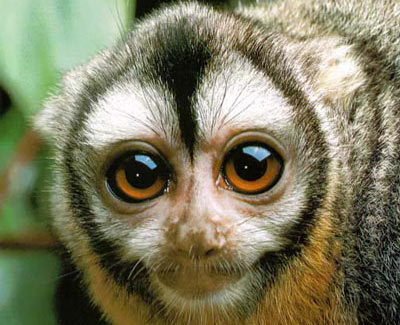
Chemistry of Love: Owl Monkeys Shed Light on Evolution of Love - [Article]
Tuesday, 29 January 2013
Monday, 17 September 2012
Size Does Matter. Brain Size!
| Big brains, but all they want to talk about is mackerel. |
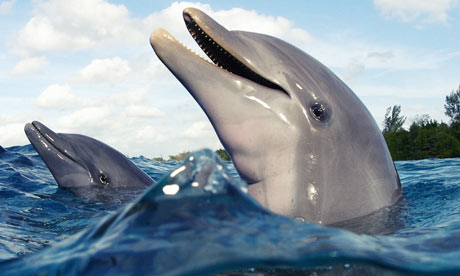
(Discover Magazine, Sept, 11, 2012) - Every whale and dolphin evolved from a deer-like animal with slender, hoofed legs, which lived between 53 and 56 million years ago.
Over time, these ancestral creatures became more streamlined, and their tails widened into flukes. They lost their hind limbs, and their front ones became paddles. And they became smarter. Today, whales and dolphins – collectively known as cetaceans – are among the most intelligent of mammals, with smarts that rival our own primate relatives.
Monday, 17 October 2011
Evolutionary Comparison Finds Shocking History for Vertebrates
| !!0_0!! |
About 500 million years ago there was probably a predatory marine fish with good eyesight, powerful jaws and sharp teeth roaming the oceans, sporting a lateral line system for detecting water movements and a well-developed electroreceptive system to sense predators and prey around it. The vast majority of the 65,000 or so living vertebrate species are its descendants.
A few hundred million years ago, there was a major fork in the evolutionary tree. One lineage led to the ray-finned fishes, or actinopterygians, and they’ve kept a weak electroreceptive system to this day. Sturgeon have receptors in the skin of their heads, for example, and the North American paddlefish has 70,000 receptors in its snout and head.
The other lineage led to lobe-finned fishes, or sarcopterygians, which in turn gave rise to land vertebrates. Some land vertebrates, including salamanders like the Mexican axolotl, still have electroreception. But in the change to terrestrial life, the lineage leading to reptiles, birds and mammals lost that electrosense and the lateral line.
The researchers took the axolotl (to represent the evolutionary lineage leading to land animals) and the paddlefish (as a model for the branch leading to ray-finned fishes) to find out the history of this sense. They found that electrosensors develop in precisely the same pattern from the same embryonic tissue in the developing skin, confirming that this is an ancient sensory system.
Also, the electrosensory organs develop immediately adjacent to the lateral line, providing compelling evidence “that these two sensory systems share a common evolutionary heritage,” said Willy Bemis, Cornell professor of ecology and evolutionary biology and a senior author of the paper.
Bemis and his colleagues will now be able to build a better picture of what the common ancestor of these two lineages looked like.
Saturday, 1 October 2011
Richard Dawkins Interview
An interview with the evolutionary biologist, best-selling author and outspoken atheist.
Thursday, 29 September 2011
'Once in a lifetime' rare white whale calf spotted off Australia
The Telegraph.co.uk (Sept. 29, 2011) - An extremely rare white humpback whale calf has been spotted near Australia's Great Barrier Reef in an event witnesses described Thursday as a "once in a lifetime experience".
Believed to be just a few weeks old, the baby humpback was seen at Cid Harbour in the famous reef's Whitsunday Islands area by local man Wayne Fewings, who was with his family in a boat when he spotted a whale pod.
"We were just drifting when I noticed the smaller whale in the pod was white. I couldn't believe my eyes, and I just grabbed my camera," Fewings said.
"Then the white calf approached my boat, seeming to want to check us out. I was just so amazed at seeing this animal, it made me think how truly astounding the Great Barrier Reef is," he added of the sighting on Saturday.
"I feel very lucky to have witnessed this, it's a once in a lifetime experience."
Reef official Mark Read said white whales were highly unusual, with only 10-15 believed to exist among the 10,000-15,000 humpbacks living along Australia's east coast, and purely white ones – like the calf spotted on Saturday – rarer still.
Its parents could both have been dark humpbacks carrying the recessive white whale gene, but Read said one or either may also have been white themselves, raising speculation it was the offspring of famous white humpback Migaloo.
Migaloo – the name is an Aboriginal word meaning "whitefella" – is the world's best-known all-white humpback and has built up a loyal following in Australia since first being sighted in 1991.
Humpback whales are currently on their southern migration and Mr Read said the baby white would be feeding heavily from its mother as it laid down fat stores for the "cold Antarctic waters."
Its sex was unknown and Read said there were no plans to bestow the young mammal with a name of its own.
"We'd be pretty comfortable for him or her just to simply remain anonymous and just live out its life in relative peace and harmony," Read said.
Australia's east coast humpback population has been brought back from the brink of extinction following the halting of whaling in the early 1960s, he added, describing it as a "conservation success story."
Wednesday, 28 September 2011
Sexy snacks: Study finds female mate searching evolves when mating gifts are important
A new study of katydids in the latest issue of the journal Proceedings of the Royal Society B -- co-authored by U of T Mississauga professor Darryl Gwynne -- supports a theory that females will search if males offer a lot more than just sperm.
"In this beast [in this study], it's a big cheesy, gooey substance that the male ejects when he copulates," says Gwynne. "It's attached to his sperm packet, so while she's being inseminated, she can reach back and grab this mating gift and eat it."
Gwynne met the lead author of the study, Jay McCartney, while on sabbatical at Massey University in New Zealand. Since part of his own research expertise covered the mating behaviours of these types of insects, Gwynne was asked to act as a co-supervisor of the project and suggested that the data could provide clues into the diversity in nature of how animals search for mates.
"Males mostly do the searching, because the Darwinian sexual selection process is typical stronger in males; they're competitive," says Gwynne." As a consequence of their eagerness to get to the females, the females just hang out waiting for the males to come to them."
In the insects that Gwynne works with, some males sing to advertise that they have a safe burrow to offer the females, while in other species, they offer the females a nutritional perk. In the katydids, where a female searched for a male, she stood to gain the largest nutritional gift.
And from the male's perspective, a large food gift not only potentially benefits his offspring, but distracts the female long enough to ensure that he has time for a full insemination. Otherwise, says Gwynne, "she's hungry…if he didn't give her this gift, she'd just pull off the sperm packet and snack on that like a little hors d'oeuvre." Gwynne says that female searching behaviour exists elsewhere in the animal kingdom -- for example, in singing animals like frogs -- and deserves further study.
Sunday, 18 September 2011
Mother Tongue Comes from Your Prehistoric Father
ScienceDaily (Sep. 17, 2011) — Language change among our prehistoric ancestors came about via the arrival of immigrant men -- rather than women -- into new settlements, according to new research.
The claim is made by two University of Cambridge academics, Peter Forster and Colin Renfrew, in a report to be published in Science on September 9.
They studied the instances of genetic markers (the male Y chromosome and female mtDNA) from several thousand individuals in communities around the world that seem to show the emergence globally of sex-specific transmission of language.
From Scandinavian Vikings who ferried kidnapped British women to Iceland -- to African, Indian and Polynesian tribes, a pattern has emerged which appears to show that the arrival of men to particular geographic locations -- through either agricultural dispersal or the arrival of military forces -- can have a significant impact on what language is spoken there.
Professor Renfrew said: "It may be that during colonisation episodes by emigrating agriculturalists, men generally outnumber women in the pioneering groups and take wives from the local community.
"When the parents have different linguistic backgrounds, it may often be the language of the father which is dominant within the family group."
Dr Forster, of Murray Edwards College, also pointed to the fact that men have a greater variance in offspring than women -- they are more likely to father children with different mothers than vice versa. This has been recorded both in prehistoric tribes such as the 19th and 20th century Polar Eskimos from Greenland and in historic figures like Genghis Khan, who is believed to have fathered hundreds of children.
Indeed, his Y chromosome is carried by 0.5 per cent of the world's male population today.
Perhaps the most striking example of sex-biased language change however comes from a genetic study on the prehistoric encounter of expanding Polynesians with resident Melanesians in New Guinea and the neighbouring Admiralty Islands. The New Guinean coast contains pockets of Polynesian-speaking areas separated by Melanesian areas. The Polynesian mtDNA level (40-50%) is similar in these areas regardless of language, whereas the Y chromosome correlates strongly with the presence of Polynesian languages.
Past studies have shown similar findings in the Indian subcontinent among the speakers of Tibeto-Burman and among the immigrant Indo-European languages as opposed to indigenous Dravidian languages.
In the Americas, too, language replacement in the course of postulated farming dispersal has also been found to correlate for the Uto-Aztecan language family.
Added Forster: "Whether in European, Indian, Chinese or other languages, the expression 'mother tongue' and its concept is firmly embedded in popular imagination -- perhaps this is the reason why for so many years the role of fathers, or more likely, specific groups of successful males, in determining prehistoric language switches has not been recognised by geneticists."
"Prehistoric women may have more readily adopted the language of immigrant males, particularly if these newcomers brought with them military prowess or a perceived higher status associated with farming or metalworking."
Journal Reference:
P. Forster, C. Renfrew. Mother Tongue and Y Chromosomes. Science, 2011; 333 (6048): 1390 DOI:10.1126/science.1205331
Wednesday, 21 July 2010
A Discovery Could Help Date Monkey-Ape Split
***TESTER BLOG***There are a few important differences between Old World monkeys and apes. Old World monkeys, like baboons and macaques, have tails and a great deal of agility, enabling them to jump and swing from tree branches.
Apes, which include gorillas and chimpanzees, are tail-less and tend to have a more upright posture. Scientists agree that Old World monkeys and apes share a common ancestry, but at some point two lineages diverged, one giving rise to the Old World monkeys and another to both apes and humans. Exactly when the split happened is a matter of debate.
A primate skull unearthed outside of Mecca in Saudi Arabia is the closest common ancestor to apes and Old World monkeys, researchers say, and helps date the split. Sediment records indicate that the fossil is 25 million to 29 million years old, making 24 million to 29 million years ago the window in which the monkey-ape split may have occurred. The ape and human lineages split later.
The research appears in the journal Nature.
“It is neither a monkey, nor an ape,” said Iyad Zalmout a palaeontologist at the University of Michigan and the study’s lead author. “You have an intermediate primate that tells you a story about Old World monkeys and apes.”
Based on the skull, the primate was medium-sized and weighed about 30 pounds to 40 pounds. It had broad upper molars and a long, baboon like snout.
A previous estimate, made with DNA samples of living primates found that the split occurred earlier, 34.5 million to 29.2 million years ago. There is however, no fossil evidence to support this.
***TESTER BLOG***