Showing posts with label primates. Show all posts

Monday, 18 February 2013

Chemistry of Love: Owl Monkeys Shed Light on Evolution of Love - [Article]


(National Geographic, 13, Feb 2013) - It may not seem like monkey business, but emotional bonds in animals such as primates may have evolved into love as we know it.


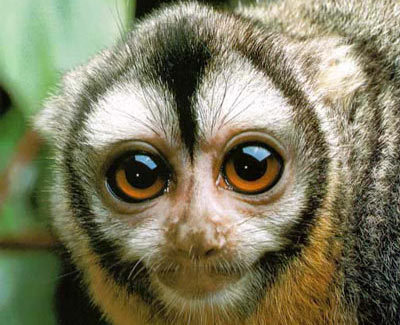
Take owl monkeys, tiny tropical tree-dwellers that treat every day like it's Valentine's Day. A male and a female stick together as long as possible, never cheat, and never "divorce" their mates—extremely unusual behavior, even among people. (Also see "Male Monkeys Wash With Urine to Attract Females?")

Sometimes, though, young adult owl monkeys that can't find mates—monkeys that scientists call floaters—pick vicious fights with established pairs, eventually kicking one of them out.

Now, new research shows that the monkeys forced to take on new partners have fewer babies than owl monkeys that haven't been broken up, said Eduardo Fernandez-Duque, a biological anthropologist at the University of Pennsylvania in Philadelphia who led a new study on owl monkey relationships.

The results show how monogamy helps owl monkeys—and may even shed light on how human relationships evolved, said Fernandez-Duque, who has received funding for his work from National Geographic's Committee for Research and Exploration. (National Geographic News is part of the National Geographic Society.)

"Call it love, call it friendship, call it marriage—there is something in our biology that leads to this enduring, emotional bond between two individuals that is widespread among human societies," Fernandez-Duque said in a statement.

Only about 5 percent of mammals are monogamous, and the phenomenon most often arises when both parents are needed to raise offspring, as in the case of people.

With owl monkeys, fathers take on most of the childcare after a baby is born, relying on the mother only for milk. (See video: "Owl Monkey Fathers Know Best?")

But floaters—which Fernandez-Duque and colleagues first noticed in 2003 in Argentina's Chaco region (map)—can spell trouble in paradise.

Drawing on nearly two decades of observations of 18 owl monkey groups, the team discovered that pairs that stay intact produce 25 percent more babies than monkeys in severed pairs.

The exiled animal from those broken relationships, meanwhile, is usually injured and often dies.

Since the team studied more than 150 animals, "I felt very confident that what he was telling us is a real phenomenon—it's not a flash in the pan," noted Patricia Wright, who was one of the first people to study owl monkeys in the 1980s.

"He had the goods on the animals. I was really excited about that," said Wright, an anthropologist at Stony Brook University in New York.

Wright said she was personally pleased that the study reinforced findings that owl monkeys stay true to one another unless forced to separate.

"I knew that these little monkeys didn't fool around," she said.

Why monkeys that are broken up have fewer babies is unknown, though Fernandez-Duque suspects there's an emotional component. (See more pictures of all-star animal dads.)

Just as a man and a woman need time to get to know each other and form a deep connection, so do owl monkeys. So when a marauding monkey enters into a new relationship, there's a delay in mating—usually about a year, Fernandez-Duque  said.

In fact, pair bonding in monogamous animals, such as owl monkeys, may be "sort of evolutionary antecedent to love in humans," said Larry Young, a behavioral neuroscientist at Emory University in Atlanta and author of the new book The Chemistry Between Us: Love, Sex, and the Science of Attraction.

Young, who studies the brain chemistry of love and emotion, does most of his research on monogamous prairie voles.

Though human love is a rich emotion reflective of our advanced brains, he said, "the foundation of that emotion is very similar to the neuromechanisms that are causing the bond between these two prairie voles."

For instance, experiments have shown that if a vole loses its partner, the "widowed" animal shows depressive symptoms—measured by a lack of willingness to escape a dangerous situation.

According to Young, our brains are in the love seat, so to speak: The organs "have evolved the mechanism to produce an emotional attachment," he said.

That attachment is spurred by oxytocin—produced during intimate contact in both people and animals—and dopamine, which is responsible for feelings of exhilaration and happiness.

So, many splendored as it is, love, he said, "is really the result of a cocktail of chemicals."

Tuesday, 23 October 2012

Big Brain Power Demands Fire Power!

Image: Madeleine Ball/Flickr
"Mmm yummy, tasty, juicy...puh puh puh!"

(Wired.com, 23, Oct 2012) - Eating a raw food diet is a recipe for disaster if you’re trying to boost your species’ brainpower. That’s because humans would have to spend more than 9 hours a day eating to get enough energy from unprocessed raw food alone to support our large brains, according to a new study that calculates the energetic costs of growing a bigger brain or body in primates. But our ancestors managed to get enough energy to grow brains that have three times as many neurons as those in apes such as gorillas, chimpanzees, and orangutans. How did they do it? They got cooking, according to a study published online today in the Proceedings of the National Academy of Sciences.

“If you eat only raw food, there are not enough hours in the day to get enough calories to build such a large brain,” says Suzana Herculano-Houzel, a neuroscientist at the Federal University of Rio de Janeiro in Brazil who is co-author of the report. “We can afford more neurons, thanks to cooking.”

Humans have more brain neurons than any other primate — about 86 billion, on average, compared with about 33 billion neurons in gorillas and 28 billion in chimpanzees. While these extra neurons endow us with many benefits, they come at a price — our brains consume 20 percent of our body’s energy when resting, compared with 9 percent in other primates. So a long-standing riddle has been where did our ancestors get that extra energy to expand their minds as they evolved from animals with brains and bodies the size of chimpanzees?

One answer came in the late 1990s when Harvard University primatologist Richard Wrangham proposed that the brain began to expand rapidly 1.6 million to 1.8 million years ago in our ancestor, Homo erectus, because this early human learned how to roast meat and tuberous root vegetables over a fire. Cooking, Wrangham argued, effectively predigested the food, making it easier and more efficient for our guts to absorb calories more rapidly. Since then, he and his colleagues have shown in lab studies of rodents and pythons that these animals grow up bigger and faster when they eat cooked meat instead of raw meat — and that it takes less energy to digest cooked meat than raw meat.

In a new test of this cooking hypothesis, Herculano-Houzel and her graduate student, Karina Fonseca-Azevedo, now a neuroscientist at the National Institute of Translational Neuroscience in São Paulo, Brazil, decided to see if a diet of raw food inherently put limits on how large a primate’s brain or body could grow. First, they counted the number of neurons in the brains of 13 species of primates (and more than 30 species of mammals). The researchers found two things: one, that brain size is directly linked to the number of neurons in a brain; and two, that that the number of neurons is directly correlated to the amount of energy (or calories) needed to feed a brain.

After adjusting for body mass, they calculated how many hours per day it would take for various primates to eat enough calories of raw food to fuel their brains. They found that it would take 8.8 hours for gorillas; 7.8 hours for orangutans; 7.3 hours for chimps; and 9.3 hours for our species, H. sapiens.

These numbers show that there is an upper limit on how much energy primates can get from an unprocessed raw diet, Herculano-Houzel says. An ape’s diet in the wild differs from a modern “raw food diet,” in which humans get sufficient calories from processing raw food in blenders and adding protein and other nutrients. In the wild, other apes can’t evolve bigger brains unless they reduce their body sizes because they can’t get past the limit of how many calories they can consume in 7 hours to 8 hours of feeding per day. But humans, she says, got around that limit by cooking. “The reason we have more neurons than any other animal alive is that cooking allowed this qualitative change — this step increase in brain size,” she says. “By cooking, we managed to circumvent the limitation of how much we can eat in a day.”

This study shows “that an ape could not achieve a brain as big as in recent humans while maintaining a typical ape diet,” Wrangham says.

Paleoanthropologist Robert Martin of The Field Museum in Chicago, Illinois, agrees that the new paper does “provide the first evidence that metabolic limitations” from a raw food diet impose a limit on how big a primate’s brain — or body — can grow. “This could account for small brain sizes of great apes despite their large body sizes.” But “the jury is still out” on whether cooking was responsible for the first dramatic burst of brain growth in our lineage, in H. erectus, Martin says, or whether our ancestors began cooking over a fire later, when the brain went through a second major growth spurt about 600,000 years ago. Hearths show up in the archaeological record 800,000 years ago and the regular use of fire for cooking doesn’t become widespread until more recently.

But to Herculano-Houzel’s mind, our brains would still be the size of an ape’s if H. erectus hadn’t played with fire: “Gorillas are stuck with this limitation of how much they can eat in a day; orangutans are stuck there; H. erectus would be stuck there if they had not invented cooking,” she says. “The more I think about it, the more I bow to my kitchen. It’s the reason we are here.”

Thursday, 4 October 2012

Busy Days at Living Links (Edinburgh Zoo)


(Living Links.org, 3, Oct 2012) - Over the past 2 weeks the Living Links team has had some busy days with visitors.

On Sunday the 23rd of September we had the St Andrews University PsychSoc visit Budongo and Living Links. They received an intro talk from Prof Andy Whiten and had guided tours from the Budongo keepers and Living Links research staff. They even had a chance to see a live demonstration of Mark Bowler and Emily Messer’s research into fur rubbing with capuchin monkeys.

"Feed me humans"

Monkey Medicine – A mini- documentary about fur rubbing can be viewed at http://vimeo.com/48287364

Then on Monday evening of the 24th of September delegates from the Animal Concepts Conference entitled Animal Welfare: Emotion, Cognition and Behaviour enjoyed two ‘talkettes’ by Prof Andy Whiten, one an introduction to the Living Links/Budongo Consortium and the other on primate minds.

The delegates also received tours of both facilities and enjoyed a brief photo shoot in the rain at our Primate Family Tree.

"Come here random zoo folk, we need a publicity photo"

Also as part of the Animal Concepts conference Dr Alex Weiss of our Living Links board gave a talk on animal personality and welfare.

"This my dear friends is a wild CHAV"

To view some of Dr.Weiss’s work on personality, visit the website below http://www.sciencedirect.com/science/article/pii/S0003347212001157

Finally, yesterday our Living Links Team presented a variety of talks to the RZSS Adult Class and again they received tours of our facilities, including a visit to the thick billed parrots with Dr Amanda Seed to see our birds partake in some cognitive research.

"If that bird shits on me again...."

Monday, 17 September 2012

Size Does Matter. Brain Size!


Big brains, but all they
want to talk about is mackerel. 

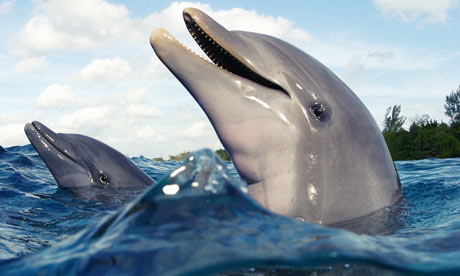
(Discover Magazine, Sept, 11, 2012) - Every whale and dolphin evolved from a deer-like animal with slender, hoofed legs, which lived between 53 and 56 million years ago. 


Over time, these ancestral creatures became more streamlined, and their tails widened into flukes. They lost their hind limbs, and their front ones became paddles. And they became smarter.  Today, whales and dolphins – collectively known as cetaceans – are among the most intelligent of mammals, with smarts that rival our own primate relatives.

Now, Shixia Xu from Nanjing Normal University has found that a gene called ASPM seems to have played an important role in the evolution of cetacean brains. The gene shows clear signatures of adaptive change at two points in history, when the brains of some cetaceans ballooned in size. But ASPM has also been linked to the evolution of bigger brains in another branch of the mammal family tree – ours. It went through similar bursts of accelerated evolution in the great apes, and especially in our own ancestors after they split away from chimpanzees.

It seems that both primates and cetaceans—the intellectual heavyweights of the animal world—could owe our bulging brains to changes in the same gene. “It’s a significant result,” says Michael McGowen, who studies the genetic evolution of whales at Wayne State University. “The work on ASPM shows clear evidence of adaptive evolution, and adds to the growing evidence of convergence between primates and cetaceans from a molecular perspective.”

For decades, we’ve known that similarities between primate and cetacean intelligence run deep. For a start, both groups have members with unusually big brains. We humans have brains that are 7 times bigger than you’d expect for an animal of their size. The equivalent number is 2-3 for chimps and some monkeys, and 4-5 for some dolphins.

Over the last decade, scientists have identified seven genes that are linked to primate brain size. They’re called MCPH1 to MCPH7 (ASPM is the fifth in the line). Faults in these genes can lead to microcephaly – a developmental disorder characterised by a debilitatingly small brain.

McGowen had already shown that, unlike in humans, MCPH1 doesn’t neatly correlate with brain size in cetaceans. Xu wanted to see if ASPM would be more interesting. He sequenced the gene in fourteen species of cetaceans, from the bottlenose dolphin to the minke whale. He then compared these to known sequences from 18 other mammals, including several primates and the hippopotamus (the closest living relative to cetaceans).

Xu found that ASPM went through two periods of strong positive selection – where beneficial new versions of the gene spread through a population. The first coincides with the point when toothed whales (like sperm whale and dolphins) split away from the baleen whales (like blue, fin and humpback whales). Their brains got bigger. The second period marks the split of the toothed whales into the delphinoids (including all oceanic dolphins and porpoises) and all the others. The delphinoids’ already big brains got bigger still.

Xu also found signatures of positive selection within the ASPM genes of primates, but not in any other mammal groups. During their history, both groups must have experienced some evolutionary pressures that meant bigger brains suddenly became advantageous. We can only speculate what these might have been. For cetaceans, the toothed whales evolved to navigate with echolocation, and may have needed a larger brain to process the information from all the returning echoes. The delphinoids may owe their larger brains to the mental demands of living in large, complex social groups. (Both hypotheses have been on the cards for some time, and Xu’s ASPM discovery doesn’t provide a smoking gun for either.)

What does ASPM actually do? The gene is activated in neuroblasts, the embryonic cells that eventually divide into neurons. It helps to create structures in dividing cells that send a full complement of DNA into each daughter. If ASPM isn’t working properly, the neuroblasts cannot divide evenly, and brains get smaller. It’s not clear how the reverse happens – how changes in ASPM lead to bigger brains, but it’s now clear that this has happened in at least two mammal groups.

Xu found certain mutations that were associated with the bigger brains of toothed whales, and others that are associated with the even bigger brains of delphinoids. What these mutations did is anyone’s guess, and something that will take a lot of experimental work to uncover.

Here’s one critical nugget, though: they’re different to the changes you see in primates. The same gene may have enlarged the brains of both groups, but it did so in different ways. And undoubtedly, other genes were also involved.

(To close, here’s possibly my favourite ever example of convergent evolution, which also involves cetaceans. Toothed whales and some bats both use echolocation, and their abilities depend on the same changes to the same gene – Prestin. This was discovered at the same time by two independent groups of researchers, one led by Yang Liu and the other by Ying Li!)

Reference: Xu, Chen, Cheng, Yang, Zhou, Xu, Zhou & Yang. 2012. Positive selection at ASPM gene coincides with brain size enlargements in cetaceans. Proc Roy Soc B.

Monday, 26 September 2011

Monkeys at typewriters 'close to reproducing Shakespeare'

The Telegraph (Sept. 26, 2011) - Millions of virtual monkeys have almost typed out the entire works of Shakespeare by bashing random keys on simulated typewriters.

The virtual monkeys, created by an American programmer, have already typed up the whole of the poem A Lover's Complaint and are 99.99 per cent of the way through the Bard's complete works.

The experiment attempts to prove the theory that an infinite number of monkeys sitting at an infinite number of typewriters would eventually reproduce the works of Shakespeare by chance.

Jesse Anderson, the programmer behind the project, said he was inspired by an episode of The Simpsons which spoofs the famous problem.

Mr Anderson set up millions of small computer programmes, or virtual monkeys, using Amazon's SC2 cloud computing system, and programmed them to churn out random sequences of nine characters.

If the nine-letter sequence appears anywhere in one of Shakespeare's writings, it is matched against the relevant passage in a copy of the Bard's complete works, and is checked off the list.

The monkeys, which started typing on August 21, have already completed more than five trillion of the 5.5 trillion possible nine-letter combinations, but have so far only finished one whole work.

But the experiment is an imperfect reproduction of the infinite monkey theorem because it saves correct sections of text while discarding future wrong guesses, experts said.

Dr Ian Steward, emeritus professor of mathematics at Warwick University, said that for the monkeys to type up the complete works in the correct order without mistakes would take much longer than the age of the universe.

He told the BBC: "Along the way there would be untold numbers of attempts with one character wrong; even more with two wrong, and so on.

"Almost all other books, being shorter, would appear (countless times) before Shakespeare did."

Writing on his blog, Mr Anderson said: "This is the largest work ever randomly reproduced. It is one small step for a monkey, one giant leap for virtual primates everywhere.

"I understand the definition of infinite and infinite monkey theorem and I realise that this project does not have infinite resources.

"No monkeys were harmed during the making of this code. This project is my attempt to find a creative way to attain an answer without infinite resources."

In 2003 the Arts Council for England paid £2,000 for a real-life test of the theorem involving six Sulawesi crested macaques, but the trial was abandoned after a month.

The monkeys produced five pages of text, mainly composed of the letter S, but failed to type anything close to a word of English, broke the computer and used the keyboard as a lavatory.

Wednesday, 21 July 2010

A Discovery Could Help Date Monkey-Ape Split

***TESTER BLOG***

There are a few important differences between Old World monkeys and apes. Old World monkeys, like baboons and macaques, have tails and a great deal of agility, enabling them to jump and swing from tree branches.

Apes, which include gorillas and chimpanzees, are tail-less and tend to have a more upright posture. Scientists agree that Old World monkeys and apes share a common ancestry, but at some point two lineages diverged, one giving rise to the Old World monkeys and another to both apes and humans. Exactly when the split happened is a matter of debate.

A primate skull unearthed outside of Mecca in Saudi Arabia is the closest common ancestor to apes and Old World monkeys, researchers say, and helps date the split. Sediment records indicate that the fossil is 25 million to 29 million years old, making 24 million to 29 million years ago the window in which the monkey-ape split may have occurred. The ape and human lineages split later.

The research appears in the journal Nature.  

“It is neither a monkey, nor an ape,” said Iyad Zalmout a palaeontologist at the University of Michigan and the study’s lead author. “You have an intermediate primate that tells you a story about Old World monkeys and apes.”

Based on the skull, the primate was medium-sized and weighed about 30 pounds to 40 pounds. It had broad upper molars and a long, baboon like snout.  

A previous estimate, made with DNA samples of living primates found that the split occurred earlier, 34.5 million to 29.2 million years ago. There is however, no fossil evidence to support this.

***TESTER BLOG***

ShareThis