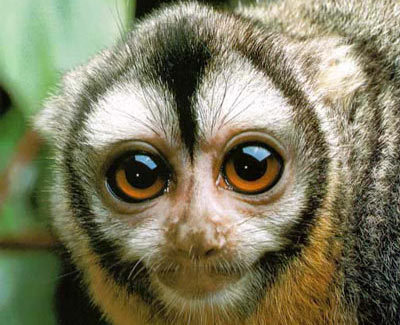
(National Geographic, 13, Feb 2013) - It may not seem like
monkey business, but emotional bonds in animals such as primates may have
evolved into love as we know it.
Journal article: Till Death (Or an Intruder) Do Us Part:Intrasexual-Competition in a Monogamous Primate
Take owl monkeys, tiny tropical tree-dwellers that treat
every day like it's Valentine's Day. A male and a female stick together as long
as possible, never cheat, and never "divorce" their mates—extremely
unusual behavior, even among people. (Also see "Male Monkeys Wash With
Urine to Attract Females?")
Sometimes, though, young adult owl monkeys that can't find
mates—monkeys that scientists call floaters—pick vicious fights with
established pairs, eventually kicking one of them out.
Now, new research shows that the monkeys forced to take on
new partners have fewer babies than owl monkeys that haven't been broken up,
said Eduardo Fernandez-Duque, a biological anthropologist at the University of Pennsylvania
in Philadelphia
who led a new study on owl monkey relationships.
The results show how monogamy helps owl monkeys—and may even
shed light on how human relationships evolved, said Fernandez-Duque, who has
received funding for his work from National Geographic's Committee for Research
and Exploration. (National Geographic News is part of the National Geographic
Society.)
"Call it love, call it friendship, call it
marriage—there is something in our biology that leads to this enduring,
emotional bond between two individuals that is widespread among human societies,"
Fernandez-Duque said in a statement.
Only about 5 percent of mammals are monogamous, and the
phenomenon most often arises when both parents are needed to raise offspring,
as in the case of people.
With owl monkeys, fathers take on most of the childcare
after a baby is born, relying on the mother only for milk. (See video:
"Owl Monkey Fathers Know Best?")
But floaters—which Fernandez-Duque and colleagues first
noticed in 2003 in Argentina 's
Chaco region (map)—can spell trouble in
paradise.
Drawing on nearly two decades of observations of 18 owl
monkey groups, the team discovered that pairs that stay intact produce 25
percent more babies than monkeys in severed pairs.
The exiled animal from those broken relationships, meanwhile,
is usually injured and often dies.
Since the team studied more than 150 animals, "I felt
very confident that what he was telling us is a real phenomenon—it's not a
flash in the pan," noted Patricia Wright, who was one of the first people
to study owl monkeys in the 1980s.
"He had the goods on the animals. I was really excited
about that," said Wright, an anthropologist at Stony
Brook University
in New York .
Wright said she was personally pleased that the study
reinforced findings that owl monkeys stay true to one another unless forced to
separate.
"I knew that these little monkeys didn't fool
around," she said.
Why monkeys that are broken up have fewer babies is unknown,
though Fernandez-Duque suspects there's an emotional component. (See more
pictures of all-star animal dads.)
Just as a man and a woman need time to get to know each
other and form a deep connection, so do owl monkeys. So when a marauding monkey
enters into a new relationship, there's a delay in mating—usually about a year,
Fernandez-Duque said.
In fact, pair bonding in monogamous animals, such as owl
monkeys, may be "sort of evolutionary antecedent to love in humans,"
said Larry Young, a behavioral neuroscientist at Emory
University in Atlanta and author of the new book The
Chemistry Between Us: Love, Sex, and the Science of Attraction.
Young, who studies the brain chemistry of love and emotion,
does most of his research on monogamous prairie voles.
Though human love is a rich emotion reflective of our
advanced brains, he said, "the foundation of that emotion is very similar
to the neuromechanisms that are causing the bond between these two prairie
voles."
For instance, experiments have shown that if a vole loses
its partner, the "widowed" animal shows depressive symptoms—measured
by a lack of willingness to escape a dangerous situation.
According to Young, our brains are in the love seat, so to
speak: The organs "have evolved the mechanism to produce an emotional
attachment," he said.
That attachment is spurred by oxytocin—produced during
intimate contact in both people and animals—and dopamine, which is responsible
for feelings of exhilaration and happiness.
So, many splendored as it is, love, he said, "is really
the result of a cocktail of chemicals."

